
In 2026, search, and local seo, is conversational, hyper-personalized, and driven entirely by Artificial Intelligence. With the aggressive rollout of “Ask Maps” and Google’s AI Overviews (AIO), Google no longer just lists businesses, it acts as a digital concierge. It synthesizes data from across the web to answer highly specific user questions in real-time, often pushing traditional search results completely off the screen.
If a user asks, “Which Miami agency knows how to lower Facebook Ad costs?” or “What size dumpster do I need for a kitchen remodel in Pasco County?”, Google’s AI instantly scans reviews, websites, and business profiles to generate a custom, text-based recommendation.
If your digital footprint isn’t optimized for how AI reads, processes, and verifies data, your business is invisible. Here is what you need to understand about the new local search landscape, the cost of ignoring it, and the specific elements your business must focus on to stay relevant this year.

The Evolution of Local SEO: From Blue Links to the “Answer Engine”
To understand where we are, you have to understand how rapidly local search has evolved.
- Era 1: The Digital Phonebook (Pre-2015). You searched for a plumber, and Google gave you a list of website links. The company with the most backlinks and highest keyword density won.
- Era 2: The “Map Pack” (2015 – 2023). Google realized people wanted proximity and social proof. They introduced the 3-Pack. The business closest to the searcher with the most 5-star ratings won the click.
- Era 3: The AI Answer Engine (2024 – Present). The algorithm stopped matching keywords and started matching intent. AI Overviews now take up roughly 40% to 50% of the screen on mobile devices.
The AI reads your reviews, crawls your website’s backend code, and analyzes your photos to confidently recommend you as the definitive answer to a searcher’s specific problem. Local SEO is now an ecosystem and not just keywords.
The new goal of local SEO is no longer to rank “Number 1” for everyone, because a static number one spot no longer exists. Results change based on the searcher’s coordinates, history, and exact phrasing. Today, the goal is to build the contextual authority required to be the AI’s top cited recommendation.
The Cost of Invisibility: What the 2026 Data Shows
If you think you can rely on the Local SEO strategies that worked in 2022, the data suggests a harsh reality check. The introduction of AI Overviews has fundamentally changed consumer behavior.
- The Rise of the “Zero-Click” Search: Recent industry data reveals that roughly 60% of all Google searches now end without a single click to a website. The AI gives the user the answer they need right on the results page. If your business’s data isn’t feeding that AI summary, the consumer never even knows you exist.
- Plummeting Click-Through Rates (CTR): When an AI Overview appears at the top of a search, traditional organic click-through rates drop by as much as 35% to 60%. Users are trusting the AI’s synthesized recommendation rather than scrolling down to do their own research.
- Confidence Over Proximity: In the past, if you were the closest coffee shop or contractor to the searcher, you won. Today, AI prioritizes confidence. If a competitor is two miles further away but has a digital footprint that explicitly proves they solve the user’s exact problem, the AI will recommend them over you.
The cost of inaction is a rapidly shrinking pipeline. If you aren’t the answer, you are buried beneath the fold.
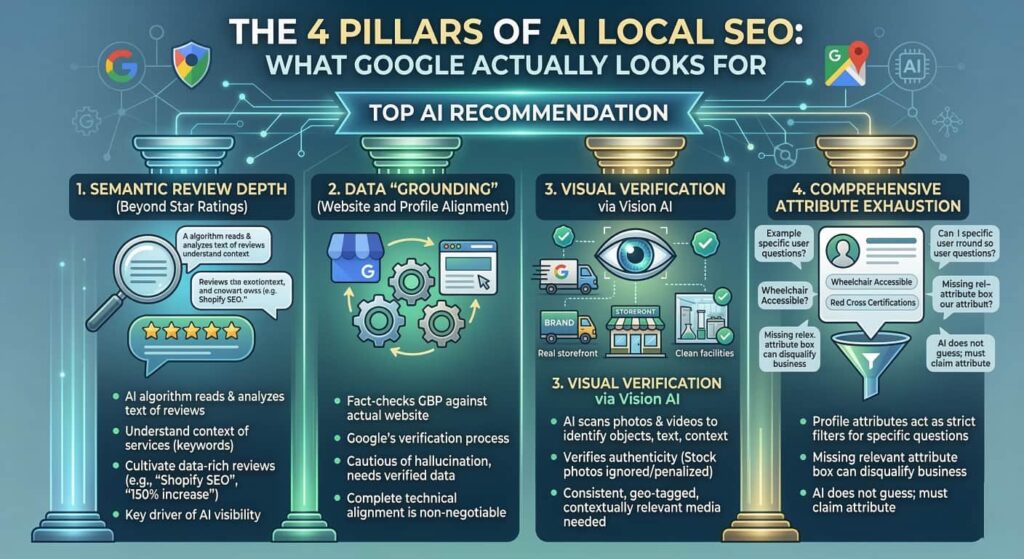
The 4 Pillars of AI Local SEO: What Google Actually Looks For
To become the AI’s top recommendation, your digital presence must satisfy a completely new set of algorithmic filters.
1. Semantic Review Depth (Beyond Star Ratings)
Having a 5-star rating is no longer enough to guarantee visibility. The AI algorithm actively reads and analyzes the text of your reviews to understand the context of your services. A review that simply says “Great job!” provides zero usable data to the AI.
However, a review that says, “They did an amazing job with our Shopify SEO and our organic traffic increased by 150% in three months,” acts as a direct, high-value ranking signal for those specific keywords. Cultivating, categorizing, and properly responding to data-rich reviews is now a primary driver of AI visibility.
2. Data “Grounding” (Website and Profile Alignment)
Google’s AI is incredibly smart, but it is prone to hallucination—so it is programmed to be cautious. Before it confidently recommends your business, it fact-checks your Google Business Profile (GBP) against your actual website. This verification process is called “grounding.”
If your GBP claims you offer emergency plumbing, but your website lacks the specific content architecture and technical data markup to verify it, the AI will hesitate. Complete, technical alignment between your site’s backend and your map listing is non-negotiable.
3. Visual Verification via Vision AI
Stock photos are actively ignored—and sometimes penalized—by modern search algorithms. Google employs “Vision AI” to literally scan your uploaded photos and videos, identifying objects, text, and context to verify your authenticity.
The AI looks for branded trucks, real storefronts, clean facilities, safety equipment, and visual proof of the services you claim to offer. Consistent, geo-tagged, and contextually relevant media uploads are now a core requirement for establishing algorithmic trust.
4. Comprehensive Attribute Exhaustion
Because users now ask Google highly specific questions (e.g., “Is this boat tour wheelchair accessible?” or “Do these swim instructors have Red Cross certifications?”), the backend attributes on your business profile act as strict filters.
Missing even one relevant attribute box in your profile setup can instantly disqualify you from appearing in hyper-specific, high-intent local searches. AI does not guess; if you don’t explicitly claim an attribute, you don’t exist for that query.
What Local SEO Looks Like in the Real World
How does this play out for different industries? It all comes down to contextual proof.
- For a B2B Marketing Agency: If a CEO searches for “B2B lead generation agency with transparent pricing,” the AI will bypass agencies with vague websites. It will highlight the agency whose website explicitly lists pricing models, backed by third-party directory citations (like Clutch or UpCity) and case studies that the AI has crawled and verified.
- For a Heavy Construction or Waste Company: If a homeowner asks, “Who rents dumpsters that won’t crack my driveway?”, the AI searches for a company whose Vision AI scan detects photos of driveway protection boards, and whose semantic reviews feature customers praising the company’s care for their property.
- For a Local Service/Tourism Business: If parents search for a “safe toddler swim school,” the AI filters out general municipal pools and exclusively recommends schools that have technical data on their site verifying CPR certifications, low student-to-teacher ratios, and family-friendly attributes.
Frequently Asked Questions About AI & Local SEO Search
Q: Will AI Overviews completely replace traditional SEO? A: No, but they have permanently changed it. Traditional SEO is now about feeding the AI. Your website still matters immensely, but its primary job is now to serve as the factual “grounding” database that the AI uses to generate its answers.
Q: How do I know if my business is being featured in AI Overviews? A: Currently, data tracking for AI Overviews is blended with traditional search data. However, if you see a spike in “zero-click” brand awareness or an increase in highly specific long-tail queries in your Google Search Console, it is a strong indicator that you are being cited as an AI source.
Q: Do local citations and directories still matter? A: Yes, more than ever. AI models prioritize “confidence.” When your business’s Name, Address, Phone number, and specific services are identically listed across dozens of authoritative industry directories, it acts as a massive trust signal to the AI that you are a legitimate, active entity.
Q: Can I just use ChatGPT to write my website content now? A: Proceed with extreme caution. Google’s algorithms are increasingly adept at identifying generic, unhelpful AI-generated fluff. To rank in 2026, your content must demonstrate E-E-A-T (Experience, Expertise, Authoritativeness, and Trustworthiness). The AI wants to cite unique, human experiences, not a regurgitation of its own training data.

Stop Chasing the Algorithm. Let Us Do It For You.
The rules of local visibility have been completely rewritten. Thriving in 2026 means constantly updating structured data, managing review semantics, feeding visual AI, and maintaining a flawless directory ecosystem.
As a business owner or marketing director, your time is highly valuable. You should be focused on running your operations, scaling your team, and closing deals, not trying to reverse-engineer Google’s latest machine-learning updates.
That is exactly what we do. At Ampliar Advertising & Marketing, we offer a completely turnkey, “done-for-you” Local SEO and AI Search Optimization service for a low, predictable monthly rate. We handle the heavy lifting: the technical website Schema markup, the weekly AI-optimized posting schedules, the directory syndication, and the semantic review strategy. We ensure that when your ideal customers ask Google for a solution, your business is the definitive, trusted answer.
Ready to dominate your local market and secure your AI visibility? Click here to contact us today to get the full details and discuss a custom, turnkey AI search strategy for your business.